24.8.07

Crows

We live in a tourist area named “The City of the Gold Coast”, which is about 1000km north of Sydney along the Pacific shore, in the state of QLD.Like most Australians, we have a private home with a garden around it.

Prior to development the area was a ‘fill’ area, for unwanted building materials and other wastes, which made it an ideal home for crows.

Although urbanized for years already, the crows are still here and we still wake up each morning to the sad sound of their good morning greetings.

Our crows are black as black can be, and fairly large; more like ravens I suppose. In contrast to European crows, they don’t jump, but walk, and they love eating fruit.

We have some passionfruit vines on the side fence, in an area that is separated from the back lawn by a corrugated metal fence. From time to time, empty passionfruit shells appear on that lawn with only a single piercing on them.

For months we wondered how come they are there, and who is the culprit. We thought, may be it’s the large fruit bats we have who eat the lycee off our tree; so we hung some old CDs on the vines to twinkle in the night with the street lights to keep them away; but with no results. The empty shells continued to turn up on the back lawn!

One day we caught them. The crows, I mean. Here they were, sneaking very very quietly, picking the fruit off the vine, and taking it to the back lawn, poking them with their beaks, and sucking the juicy fruit out!

What are we to do? We had no idea, so we succumbed. We decided that nature is getting its way, and all we have to do is to be quicker than the crows in getting the fruit onto our dining table.

In Israel, we are staying in an area, which is also a tourist area. Here, along the Mediterranean Sea, they have the most beautiful promenade you can imagine.

And here, the local crows make sure to spoil the promenade with their most unhygienic eating habits.

Every morning, when we are out for our morning walk, we see them emptying the cover-less rubbish bins from all their previous night leftovers, feasting to their heart content and leaving an unbelievable mess around.

These crows are very different in looks and in behaviour. They are not just black. Their wing, tail and head are black but their body is faun to light brown. Some of them have also a black bib in the front.

They also do not just walk or just hop.They do both; walking and hoping. They walk when they have time to enjoy their surrounds, hop when they are in a hurry, and before a flight lift off.You can see them walk, then, start hoping, then, comes the lift off.

Crows have, for some reason, got an eerie attitude developed towards them throughout the ages. I think it is because of their sad crying type of voice. However, when you bother to look at them and observe them, they are a very beautiful bird with a deep and rich colour and a lovely shape.

Renate

Artist, poet & the Author of

From the Promised Land to the Lucky Country

http://www.promisedland-renate.com/

14.8.07

The Dead Sea Works

Hi, Sorry to be so tardy this time, but I have been busy uploaded some poems into my web site, which you may like to read as well. You'll find the address at the bottom of this posting. Also, the material I wanted to share with you was not easy to put together. It's very involved, very informative and there is a lot about it and in it. So I had to ensure it's not too long and not too confusing. So lets go,

I have seen an interesting documentary about the ‘The Dead Sea Works’ and I thought to share it with you.

As you well know the Dead Sea, which in Hebrew is called ‘The Salt Sea’ and is not dead at all, is the lowest point on earth (400 meters below sea level). It is nourished by the Jordan River and by sweet water springs that are at its bottom.

With the area being so rich with minerals, the weather so very hot and water evaporation extreme, a high concentration of minerals in the water increases.

(When you go in to bathe, you cannot drown because the water will lift you. you can even lie there and read a book I you so desire. However, I will not recommend it; this high mineral concentration will burn your skin mercilessly.)

In the 1911 the Zionist mining engineer Moshe Novomeysky, who was an expert in salt mining, visited the area and saw its great salts mining potential.

During the ensuing years, Novomeysky made several tests and examination; and with the land coming under British Mandate rule in 1917, he sought and fought hard for a concession to extract those minerals salts.

In May 22, 1929, and against all odds, after the Land of Israel was divided in 1922 with the east of the Jordan River, which was 79% of the total area, becoming Trans-Jordan, the man received his concession.

This concession granted him an area of just four square kilometers of land at the northwestern end of the Dead Sea. Here he started his project, employing Jews and Arabs alike in complete harmony.

Later in the piece, an added concession was received for a plant at the southern part of the Dead Sea.

In 1939 Kibbutz Beit HaArava was found next to the northern plant not far from the Jordan River. Its members not only worked in the plant, but also made their home there. They built, already in those days, ecological friendly buildings, and washed the clay land off its salt with water from the Jordan River; to plant trees and grow the best and the most tasty vegetables ever.

I had the privilege of visiting this place in my early teens. It was an oasis in the wilderness populated with people of great vision and foresight and courage.

With Jordan conquering the area in Israel’s War of Independence together with what is called to day the ‘West Bank’, the northern works and the kibbutz were vacated. Within few days the whole area was plundered & destroyed by the Arabs, including the mining plant and all the kibbutz’s achievements. The southern plant, which is situated where the Biblical city of Sdom (Sodom & Gomorra) used to be, continued its work.

In 1955 the Dead Sea Works, backed by the Israeli government, expended along the Dead Sea and in the Negev, and is today the world leader in the production of various minerals.

Renate

Artist, poet & the Author of

From the Promised Land to the Lucky Country

http://www.promisedland-renate.com/

2.8.07

A day in the kitchen

You would not believe it, but it’s 8am and I have decided to cook.

My husband, who stands not far from me, has already a knowing smile on his face.

I say, ‘what’s so funny?’

He says, ‘ Did I say anything?’

I say, ‘no, but your face says it all. So what’s so wrong with me wanting to cook?’

He says nothing. He just looks at me and grins.

You see, I cannot cook, nor do I like cooking. My mother was no example. She hated cooking and it showed.

When I went to the army at the age of 17, I thought the food was terrific! It’s only few years ago, and I am now 76 years old, that I learnt one must loath army food…

Well, I need stay just 5 minutes in the kitchen not eating, and he comments, ‘What are you doing? Spoiling the food?’

So here I am:I bought a couple of eggplants and some mincemeat and decided to make something like the Greeks do – something like moussaka.

I took some millet and some buckwheat. Cooked them in water together with some linseed and some condiments I found in the cupboard, which I though will be nice.

I cut some onion and garlic, fresh basil and parsley, all organic mind you, and cut the eggplant in thin slices.

I layered it all nicely with the mince I mixed with some organic tomato paste and then –

I have a convection/micro oven combination, even though we do not use the micro at all; and the oven very seldom. Why? Because the oven speaks only French, and we do not.

Luckily, it has some icons on it with marking that show what they are for, and we know what poule viande and poisson mean.

I set the temperature to 180c degrees and wait for the oven to heat up. It does.

It beeps and I know I got that one right.

I also know that when it beeps, I need to open the door and put the food in. I do that. Then…? Um…. What do I do next?

I try one setting after the other, and another, and I think I got it right. I wait an hour - but nothing happens.

I raise the setting to 200c, and try some settings I didn’t try before, and it works. Hallelujah.

I wait another hour. The oven beeps again. The food is hot, the mince is cooked; the eggplant is not.

My husband says, ‘ how about giving up on the oven and transfer the food into a saucepan?’

He says, ‘ Make sure it stays the shape it is in.’

I tip the content over into the pen and it keeps its shape, but I am not happy with it, so I pock it and flatten it to fit the whole area. Now it looks good.

I say, ‘I’ll cook it on a low flame. I think it will cook the eggplant better that way.’

He says, ‘Good idea.’

It cooks for another hour and the time is 8pm.

Now it’s ready, but it’s too late and it's too hot to eat. We have about 36c and humidity of 70% and we think,

Watermelon will be nice...

Renate Artist, poet & the Author of

From the Promised Land to the Lucky Country

http://www.promisedland-renate.com/

27.7.07

Nature and us Humans

In my last posting I wrote about the culture of cutting trees and the results that follow, as well as a way to combat this negative trend.

Today I wish to enlarge on this subject, as it did not leave my mind since my last posting, so here I am:

Unfortunately, we in the western world have instituted a negative way of looking at nature and much of what we do, and the way we live, is contra to nature’s laws: We fight nature instead of going hand in hand with it. We poison everything that crosses our way, and our scientists do all kind of changes in nature to ‘better’ it.

I feel, and am convinced, that in the long run, we of the Human race will be the losers. Nature does not really care if we survive of not. Nature adjusts. It changes, and the changes it does are slow, but are the ones that keep everything in working balance.

I INDICT YOU MAN
(Nature verses man)

I indict you man
Before Heaven and Earth,
I indict you man:

I indict you man for polluting
The breathing air,
The drinking water,
The food for eating,
I indict you.

I indict you man
For cutting forests,
For diverting rivers,
For moving mountains,
I indict you.

I indict you man for the loss
of beast on land,
Of fish in water,
Of birds in sky
I indict you.

I indict you man
For high-rise ghettos
And asphalt pollution
I indict you.

I indict you man
For nuclear radiation and waste,
For deformities and death,
I indict you.

I indict you man for destruction
I indict you man for you are the destroyer,
I indict you man for I am Nature
And I, Indict you -
Man…

©Renate All rights reserved, June, 1992 renate555@gmail.com

Renate

Artist, poet & the Author of

From the Promised Land to the Lucky Countryhttp://www.promisedland-renate.com/

15.7.07

Climate warming

A great part of Climate change is attributed to the cutting of trees. It has brought about the formation of new deserts, dust bowls and the rise of salt that makes the land infertile.

In contrast to Australia and other countries like her that have systematically cut trees to make way to mono-agriculture of annual, the Jews returning to their homeland have been vigorously planting trees in this ancient land.In just 100 years bare mountains and dessert areas changed their colour to green with over 223 millions trees taking root here.

Recently, an international climate warming and afforestation conference took place in Israel.It centred on achievements reached here and the way those came about.

In the arid Negev Dessert, Israel has successfully planted 2 forests, where the trees are already more than twice the size of man; and where the undergrowth feeds the livestock of the Bedouins, that live in that area.

Israel scientists carefully pick the type of plants to be planted, and constantly watch and study their growth and behaviour.They look into water consumption as well, and utilize the most modern water conservation and utilization systems, which have been devised in this land.These forests even though the driest in the world, are doing well.

As this subject is important to us all, I would appreciate your input,your thoughts and ideas on it.

Renate

Artist, poet & the Author of From the Promised Land to the Lucky Country

http://www.promisedland-renate.com/

7.7.07

The wedding on mount Carmel

One of the well-known mountain ridges here is the Carmel Mountains ridge, and we were invited to a wedding ceremony and party that took place in one of its peaks. This peak is called ‘The Hagana’- 'the Protector'- which was the forerunner to Israel’s defence forces. The area here is a designated as a picnic area and is covered with trees.It has a modern stone memorial sculpture with the military insignia on it, and a round opening through which you can see the surrounding area below. From this peak you can see: from the Mediterranean Sea and the City of Haifa to the valley of Zebulon, where the tribe of Zebulon lived in the days of the tribes, and right into the valley of Izrael. Here you can see the city buildings and industry, as well as the fields of the agricultural settlements that dot this rich land area. As darkness falls the day’s colour change and there are no longer the blues the greys and the green, but the lights, in their various shades of colours, that light in the blackness of night like millions of twinkling stars.What a sight! Arriving close to 8pm, and still light, we found the whole area set up for around 300+ guests, in tables for 10. These were covered with ochre yellow table clothes and set up like in a 5 star hotel. There was a stage for music and a dancing platform on to one side, and about three or four long buffet tables around. But that was not all, there were also two tables cooking pre –sitting food that constantly prepared ‘little bits of heaven’ Israeli style,’ with circulating waiters that served an array of local savouries. A drink counter was set opposite, serving anything you like; from water and soft drinks to pure fruit juices made on the spot to alcoholic beverages and mixes. At one corner, was a platform on which the ‘Chupa”(the traditional canopy under which Jewish weddings are held) was erected. Through which one could see the view below as well. In this beautiful night and site, a young couple vowed their life to each other, with the groom closing the ceremony by saying to his bride; you are the most wonderful, fantastic present I have ever got.I thank you for loving me. As a present, I gave them a digital copy of my 2 pods & white flowers on a dark green background. At the back we wrote, 'We wish your life together would flourish as beautiful as the subjects in the painting.' Renate Artist, poet & the Author of From the Promised Land to the Lucky Country http://www.promisedland-renate.com/
3.7.07

Visiting Israel - feel the place

I am in Israel now and intend staying here for sometime. It’s a fascinating place.Its history, location, situation and problems are unique.They differ greatly from those in other countries because of its position as a holy place to the world’s 3 monotheistic religions; and because its the Jewish people’s only homeland. It is an integral part of their history and beliefs.

The re-establishment of Israel as a state after 2000 years of exile makes the place even more unique. Here antiquity and modernism come together; and a bridge from the past to the present and to the future is constantly being built.

Israel is a very modern country. She is a powerhouse to the High Tech world and a leader in many other fields as well. It’s a democracy, where the democracy has perhaps gone too far: many opinions, far too many political parties, and a very open debate over every issue that comes along.

In less than 100 years, the growing Jewish population has turned the dessert made by the Ottoman Empire (Turkish) in its 400 years rule, to a garden.Trees and flowering shrubs, as well as flowers are everywhere, and the people are keen on planting to such a degree, that many verandas and rooftops are green with a large variety of large plants.

Israel topography makes this place unique as well. In such a small country the landscape changes rapidly: from white sandy beaches to mountain ridges, to valleys, and right down to the lowest spot on earth – The Dead Sea.And by the way, the Dead Sea, which in Hebrew is called – the Salt Sea, is not really ‘Dead’; and it is interesting to note that at its centre, at the very bottom of it, are sweet water springs.

Next post - Wedding on Mount Carmel. Renate Artist, poet & the Author of From the Promised Land to the Lucky Country http://www.promisedland-renate.com/


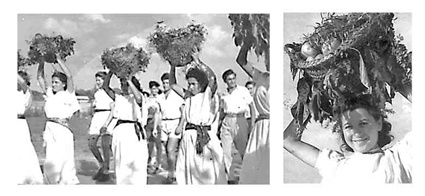
Bicurim feast in the kibbutz highschool
Hi Walter and Annette, Thanks for the feedback. Pleased you enjoyed reading it. What happened to the boat, comes in a period after the book ends and maybe a part of the next book...