Showing posts with label Israel. Show all posts

19.6.08

ISRAEL'S ACHIEVEMENTS IN THE FIRST MONTH OF 2008

Israel, with a population of around 7 millions, and only 20,770 sq km of land, is one of the 100 smallest countries in the world. (Even smaller than New Jersey).

Even though so small, Israel contributes in a large way to the betterment of our daily life.

On the right side of this blog there is a column about Israel achievement, which I have posted about a year ago. Since then, Israel has achieved many other things of which I have no record. However, I was lucky to get a list of her achievement during the month of January of this year alone, and thought you may like to read it as well. So here it is:

1. Scientists in Israel, found that the brackish water, drilled from underground desert aquifers, hundreds of feet deep, could be used to raise warm-water fish. The geothermal water, less than one-tenth as saline as sea water, free of pollutants, and a toasty 98° on average, proves an ideal environment.

2. Israeli-developed designer-eyeglasses, promise mobile phone and iPod users, a personalized, high-tech video display. Available to US consumers next year, Lumus-Optical's lightweight and fashionable video eyeglasses, feature a large transparent screen, floating in front of the viewer's face that projects their choice of movie, TV show, or video Game.

3. When Stephen Hawkins visited Israel recently, he shared his wisdom with scientists, students, and even the Prime Minister. But the world's most renown victim of amyotrophic lateral sclerosis (ALS), or Lou Gehrig's disease, also learned something, due to the Israeli Association for ALS' advanced work in both embryonic and adult stem cell research, as well as its proven track record with neurodegenerative diseases, the Israeli research community is well on its way, to finding a treatment for this fatal disease, which affects 30,000 Americans.

4. Israeli start-up, Veterix, has developed an innovative new electronic capsule that sits in the stomach of a cow, sheep, or goat, sending out real-time information on the health of the herd, to the farmer via Email or cell phone. The e-capsule, which also sends out alerts if animals are distressed, injured, or lost, is now being tested on a herd of cows, in the hopes that the device will lead to tastier and healthier meat and milk supplies. <<>

5. The millions of Skype users worldwide will soon have access to the newly developed KishKish lie-detector. This free internet service, based on voice stress analysis (a technique, commonly used in criminal investigations), will be able to measure just how truthful that person on the other end of the line, really is.

6. Beating cardiac tissue has been created in a lab from human embryonic stem cells by researchers at the Rappaport Medical Faculty and the Technion-Israel Institute of Technology's biomedical Engineering faculty. The work of Dr. Shulamit Levenberg and Prof. Lior Gepstein, has also led to the creation of tiny blood vessels within the tissue, making possible its implantation in a human heart.

7. Israel's Magal Security Systems, is a worldwide leader in computerized security systems, with products used in more than 70 countries around the world, protecting anything from national borders, to nuclear facilities, refineries, and airpo rts. The company's latest Product, DreamBox, a state-of-the-art security system that includes Intelligent video, audio and sensor management, is now being used by a major water authority on the US east coast to safeguard the utility's sites.

8. It is common knowledge that dogs have better night vision than humans and a vastly superior sense of smell and hearing. Israel's Bio-Sense Technologies, recently delved further, and electronically analyzed 350 different barks. Finding that dogs of all breeds and sizes, bark the same alarm when they sense a threat, the firm has designed the dog bark-reader, a sensor that can pick up a dog's alarm bark, and alert the human operators. This is just one of a batch of innovative security systems to emerge from Israel, which Forbes calls 'the go-to country for anti-terrorism technologies.'

9. Israeli company, BioControl Medical, sold its first electrical stimulator to treat urinary incontinence to a US company for $50 Million. Now, it is working on CardioFit, which uses electrical nerve stimulation to treat congestive heart failure. With nearly five million Americans presently affected by heart failure, and more than 400,000 new cases diagnosed yearly, the CardioFit is already generating a great deal of excitement as the first device with the potential to halt this deadly disease.

10. One year after Norway's Socialist Left Party launched its boycott Israel campaign, the importing of Israeli goods has increased by 15%, the strongest increase in many years, Statistics Norway reports.

Renate

Artist, poet and the author of

'From the Promised Land to the Lucky Country'

To look inside my book Click here

To see more of my book click on this link

http://www.promisedland-renate.com 

12.1.08

A tree from biblical times

Gerry said,

‘Come. I must show you something.’

‘Show me what?’

‘You’ll see’

He took me by the hand and led me behind the new art centre to the old part of Natanya, and I was surprised.

What is there to see at this end of town?

We got to a small park, and he stopped.

‘Look at this tree’ he said pointing to a very large sycamore,

‘It stands here from the days of old Israel.It is over two thousand years old!’

And what a tree: A trunk five meters wide at its widest angle; with a huge canopy, full of fruit and leaves and very much alive.

Looking at it I wondered at the travellers it met, the wars he lived through and the lovers under its shade.

From long into antiquity the Land of Israel was a transit land between three continents: between Europe, Africa and Asia.It had two main routes passing through it: one along the Mediterranean shore and the other over the mountain ridge; and it may very well be that this tree stood beside the main route along the sea.

Egypt in the south, and the Hittites, Assyrian and Macedonians to the north, to name only a few, used these highways for commerce and their none-ending wars; in their quest for the then world domination.The ‘King’s Way’ was the one along the seashore, in Hebrew - Derech Hamelech, and the other -Derech HaHar – meaning - The ‘Mountain Route’.

Standing there the uniqueness of the place overtook me. I looked, wondered and wished I could communicate with it.

We returned, several times, to this small park that is not even a street away from the hustle and bustle of Natanya’s main street. We shot day, twilight and night photos, when the tree is floodlit, and included some here for your enjoyment.

A day shot Floor painting done by a traveler in 1873
At this angle, the trunk is 5m wide
A part of very old branch
The fruit on its branches
The tree at twilight
A night shot
A branch at night
Renate

http://www.promisedland-renate.com

24.12.07

Chanukah - the festival of light

In this festive season Christians celebrate Christmas and Jews have already celebrated Chanukah. But what is Chanukah all about, this ‘Festival of Light’? What does it celebrates? Where does it take its name? From how far in history does it echo? And what is its message? Chanukah celebrates a miracle that happened about two thousand one hundred and fifty years ago. After the death of Alexander the great in 323BC when its empire was divided between his generals, the Seleucid dynasty came into being. The Seleucid, who ruled the area of Israel and Judea, continued Alexander’s policy of Hellenizing their territories. Around the year 200B.C the Seleucid Antiochus IV came to power. Frustrated with his inability to Hellenize the Jews he eventually converted The Second Temple in Jerusalem to a house of pagan idol worship.
map of Jerusalem in antiquity.
The Second Temple is considered to be one of the seven wonders old world
In 167BC after three years of guerrilla warfare, against a numerically superior army, man named Yehuda haMaccabi(judas Maccabeus), son of Matityahu (Mattathias), recaptured Jerusalem and the Temple Mount, cleansing it from all idols. After the Temple was cleansed, Yehuda and his men wanted to rekindle the temple’s eternal flame. They hunted high and low to find some blessed oil needed to light the flame on its seven-branched golden Menorah (candlestick), but all they could find was a tiny clay pot, which had enough oil for just one day. On the 25th day of the Jewish month of Kislev, which corresponds to sometimes in the month of December, a miracle occurred and the Menorah lit for eight days, giving enough time for fresh oil to be brought up to Jerusalem.
The entrance to the Temple area
Chanukah lasts for 8 days, signifying this event. Every evening during these days the chanukiyah (the special candlestick used only in Chanukah) is ceremoniously lit with an additional candle for each night. On the last night all eight candles are alight, as well as the service candle used to light the others. However, Chag (feast) HaChanuka celebrates not only the recapturing of the Temple, when Judaism was the only monotheistic religion in a sea of paganism, but also the survival of the Jewish spirit and culture. At the same time it raises awareness to the right of freedom over oppression. Chanukah is a happy celebration, where people sing songs, play games and eat sweet and oily foods to denote the miracle.
We have come to evict the darkness, In our hands a fire so bright, Each of us is a small candle Together we are eternal light. Disperse, oh black darkness, Disperse! Here comes the light!
Renate http://www.promisedland-renate.com/

21.10.07

Masada – ‘Metzada’ in Hebrew – freedom or death

We are driving along the only road that leads through the Judean Desert south towards Masada. All is bare but for a patch of green here, and another one there, denoting a kibbutz; where a lot of effort is put in to make this desert bloom; a vast rocky emptiness that is hard to comprehend.

How can I make you feel this vastness? This emptiness? Its deadness if I can call it that way, even though there is life everywhere.I thought of showing you all that we have filmed, but then it will go forever, and still, it will not be it, will it?The Hebrew calls it‘נורא הוד ‘ (Nora hod) but I cannot find the English equivalent. If any of you can, please let me know.

It is hard to comprehend that people in biblical times lived in this environment by choice, in small settlement like in Qumran, or in caves one can see along the way, till you realize that living here was better than living under the noses of the so cruel Romans.

<

The Judean wilderness, a kibbutz in the distance

Deep in the Judean desert, 450 meter above and overlooking the now receding Dead Sea, stands the mighty fortress rock of Masada. Majestic in its beauty, and fascinating in its history, it is a place of pilgrimage to all Israelis and many others around the world.

the rock of Masada

Arial map in blue

Here, after 3 years of siege, about 960 people chose death in freedom over life in slavery – Roman slavery, and I quote out of Josephus:

“Since we long ago resolved never to be servants to the Romans, nor to any other than to God Himself, Who alone is the true and just Lord of mankind, the time is now come that obliges us to make that resolution true in practice... Let our wives die before they have been abused, and our children before they have tasted slavery, and after we have slain them, let us bestow that glorious benefit upon one another mutually, and preserve ourselves in freedom.We were the very first that revolted, and we are the last to fight against them; and I cannot but esteem it as a favour that God has granted us, that it is still in our power to die bravely, and in a state of freedom.”

From Elazar benYair final speech (the Zealots Commander)

At the end of the 3-year siege, when at long last the fortress walls were breached, the Roman got the surprise of their lives - they were greeted with silence.

There was nothing for the ‘Triumph Parade’.No slaves for sale.

Apart of two women and five children that hid themselves, there were only dead bodies…

With the fall of Masada, the last resistance to Roman rule came to an end. Jerusalem was in ruin already and the temple no longer stood. After one more revolt in 132-135, Rome had enough. To ensure the Jews will no longer rise against her, the population was dispersed throughout the Roman world and Judea’s name was change to ‘Palestina’ – a name they coined from the name of the Philistines – the Anatolian ‘sea people’ who lived along the southern Mediterranean shore of the country and were long gone by that time.

Nowadays, Israeli soldiers take here the oath: "Masada shall not fall again."

Masada was first fortified was by ‘Jonathan the High Priest’ who lived in103-76 BCE.

Between the years 37 and 31 BCE ‘Herod the Great’, the crazy king, who killed anyone at a whim including his wife and children, and one of the world’s greatest architect, built into this rock his fortified 3 level summer palace, overlooking the Dead Sea. A palace in the best of Roman style; fit not only for a king but for an emperor as well. Here as in any other place he built, Herod spared nothing: Palaces and villas, throne room and synagogue; water cisterns, bathes, frescoes and storerooms and more.

Harod’s palace overlooking the Dead Sea

After the fall of Jerusalem and the destruction of the magnificent Temple, crazy Herod built; a group of zealots took Masada over.

Around 73 CE, Rome collected her best legions from all over its empire, and from as far as Britain, to lay the 3-year siege of Masada. They brought with them thousands of Jewish prisoners-of-war slave labour, to build rampart of thousands of tons of stones and beaten earth against the western approaches of the fortress; and battering rams to breached its walls.

Part of the way up the rock of Masada

View from above onto the Roman camp area

As you stand at the top of Masada looking down, you can still see the Roman army’s camp area and that of the slave’s as well.

The Roman rampant

There is so much about Masada to study and so many lessons to learn.Books were written and still are, and theories developed. Archaeologist have turned over and looked into every nock and cranny of this place, and Josephus, the Jewish General who fought the Romans in the Galilee and later Romanised to become the emperor’s friend and historian, left in his book ‘The wars of the Jews’ the only account we have today from that time in the history of the holy land.

Renate

http://www.promisedland-renate.com

If you want to know more go to

Masada photos

http://fourquestions.us/albums/Israel2006/Masada/photos/photo2.html

Masada history

http://www.jewishvirtuallibrary.org/jsource/Archaeology/Masada1.html

9.10.07

Promenade – Natanya

In 2004 Netanya’s promenade it won Israel’s prize for the most beautiful the country has, and justly so. I have seen none better anywhere I traveled, be it in Israel or anywhere else I have been.

The promenade that runs for about 4 –5 kilometers or more on a cliff along the Mediterranean Sea, half way between Tel Aviv and Haifa, is not yet finished, and you constantly see new things added to it. It will eventually join a large park that work on it has only recently started.

In my ‘Crows” post I displayed a couple of photos from the newer part of this promenade, and my Sand Lilies come from there as well. Now I’d like to take you to some of the older parts.

My husband and I got up one morning with camera in hand and started photographing.Back in our room I looked at what I got and the choice was overwhelming. We had so many and varied photos, making the choosing very difficult.

I sorted the photos into groups and picked out some of each, in the hope of giving you a taste and an idea on how beautiful this promenade really is.

So lets go

Artist, poet & the Author of From the Promised Land to the Lucky Country

http://www.promisedland-renate.com/

6.9.07

Sand Daffodil or Sand Lily – חבצלת החוף

I thought you'd like to see this most magnificent plant, which is a native of the Mediterranean. We found it everywhere on that promenade you saw in my posting about the crows.

Enjoy,

Renate Artist, poet & the Author of From the Promised Land to the Lucky Country http://www.promisedland-renate.com/

24.8.07

Crows

We live in a tourist area named “The City of the Gold Coast”, which is about 1000km north of Sydney along the Pacific shore, in the state of QLD.Like most Australians, we have a private home with a garden around it.

Prior to development the area was a ‘fill’ area, for unwanted building materials and other wastes, which made it an ideal home for crows.

Although urbanized for years already, the crows are still here and we still wake up each morning to the sad sound of their good morning greetings.

Our crows are black as black can be, and fairly large; more like ravens I suppose. In contrast to European crows, they don’t jump, but walk, and they love eating fruit.

We have some passionfruit vines on the side fence, in an area that is separated from the back lawn by a corrugated metal fence. From time to time, empty passionfruit shells appear on that lawn with only a single piercing on them.

For months we wondered how come they are there, and who is the culprit. We thought, may be it’s the large fruit bats we have who eat the lycee off our tree; so we hung some old CDs on the vines to twinkle in the night with the street lights to keep them away; but with no results. The empty shells continued to turn up on the back lawn!

One day we caught them. The crows, I mean. Here they were, sneaking very very quietly, picking the fruit off the vine, and taking it to the back lawn, poking them with their beaks, and sucking the juicy fruit out!

What are we to do? We had no idea, so we succumbed. We decided that nature is getting its way, and all we have to do is to be quicker than the crows in getting the fruit onto our dining table.

In Israel, we are staying in an area, which is also a tourist area. Here, along the Mediterranean Sea, they have the most beautiful promenade you can imagine.

And here, the local crows make sure to spoil the promenade with their most unhygienic eating habits.

Every morning, when we are out for our morning walk, we see them emptying the cover-less rubbish bins from all their previous night leftovers, feasting to their heart content and leaving an unbelievable mess around.

These crows are very different in looks and in behaviour. They are not just black. Their wing, tail and head are black but their body is faun to light brown. Some of them have also a black bib in the front.

They also do not just walk or just hop.They do both; walking and hoping. They walk when they have time to enjoy their surrounds, hop when they are in a hurry, and before a flight lift off.You can see them walk, then, start hoping, then, comes the lift off.

Crows have, for some reason, got an eerie attitude developed towards them throughout the ages. I think it is because of their sad crying type of voice. However, when you bother to look at them and observe them, they are a very beautiful bird with a deep and rich colour and a lovely shape.

Renate

Artist, poet & the Author of

From the Promised Land to the Lucky Country

http://www.promisedland-renate.com/

14.8.07

The Dead Sea Works

Hi, Sorry to be so tardy this time, but I have been busy uploaded some poems into my web site, which you may like to read as well. You'll find the address at the bottom of this posting. Also, the material I wanted to share with you was not easy to put together. It's very involved, very informative and there is a lot about it and in it. So I had to ensure it's not too long and not too confusing. So lets go,

I have seen an interesting documentary about the ‘The Dead Sea Works’ and I thought to share it with you.

As you well know the Dead Sea, which in Hebrew is called ‘The Salt Sea’ and is not dead at all, is the lowest point on earth (400 meters below sea level). It is nourished by the Jordan River and by sweet water springs that are at its bottom.

With the area being so rich with minerals, the weather so very hot and water evaporation extreme, a high concentration of minerals in the water increases.

(When you go in to bathe, you cannot drown because the water will lift you. you can even lie there and read a book I you so desire. However, I will not recommend it; this high mineral concentration will burn your skin mercilessly.)

In the 1911 the Zionist mining engineer Moshe Novomeysky, who was an expert in salt mining, visited the area and saw its great salts mining potential.

During the ensuing years, Novomeysky made several tests and examination; and with the land coming under British Mandate rule in 1917, he sought and fought hard for a concession to extract those minerals salts.

In May 22, 1929, and against all odds, after the Land of Israel was divided in 1922 with the east of the Jordan River, which was 79% of the total area, becoming Trans-Jordan, the man received his concession.

This concession granted him an area of just four square kilometers of land at the northwestern end of the Dead Sea. Here he started his project, employing Jews and Arabs alike in complete harmony.

Later in the piece, an added concession was received for a plant at the southern part of the Dead Sea.

In 1939 Kibbutz Beit HaArava was found next to the northern plant not far from the Jordan River. Its members not only worked in the plant, but also made their home there. They built, already in those days, ecological friendly buildings, and washed the clay land off its salt with water from the Jordan River; to plant trees and grow the best and the most tasty vegetables ever.

I had the privilege of visiting this place in my early teens. It was an oasis in the wilderness populated with people of great vision and foresight and courage.

With Jordan conquering the area in Israel’s War of Independence together with what is called to day the ‘West Bank’, the northern works and the kibbutz were vacated. Within few days the whole area was plundered & destroyed by the Arabs, including the mining plant and all the kibbutz’s achievements. The southern plant, which is situated where the Biblical city of Sdom (Sodom & Gomorra) used to be, continued its work.

In 1955 the Dead Sea Works, backed by the Israeli government, expended along the Dead Sea and in the Negev, and is today the world leader in the production of various minerals.

Renate

Artist, poet & the Author of

From the Promised Land to the Lucky Country

http://www.promisedland-renate.com/

7.7.07

The wedding on mount Carmel

One of the well-known mountain ridges here is the Carmel Mountains ridge, and we were invited to a wedding ceremony and party that took place in one of its peaks. This peak is called ‘The Hagana’- 'the Protector'- which was the forerunner to Israel’s defence forces. The area here is a designated as a picnic area and is covered with trees.It has a modern stone memorial sculpture with the military insignia on it, and a round opening through which you can see the surrounding area below. From this peak you can see: from the Mediterranean Sea and the City of Haifa to the valley of Zebulon, where the tribe of Zebulon lived in the days of the tribes, and right into the valley of Izrael. Here you can see the city buildings and industry, as well as the fields of the agricultural settlements that dot this rich land area. As darkness falls the day’s colour change and there are no longer the blues the greys and the green, but the lights, in their various shades of colours, that light in the blackness of night like millions of twinkling stars.What a sight! Arriving close to 8pm, and still light, we found the whole area set up for around 300+ guests, in tables for 10. These were covered with ochre yellow table clothes and set up like in a 5 star hotel. There was a stage for music and a dancing platform on to one side, and about three or four long buffet tables around. But that was not all, there were also two tables cooking pre –sitting food that constantly prepared ‘little bits of heaven’ Israeli style,’ with circulating waiters that served an array of local savouries. A drink counter was set opposite, serving anything you like; from water and soft drinks to pure fruit juices made on the spot to alcoholic beverages and mixes. At one corner, was a platform on which the ‘Chupa”(the traditional canopy under which Jewish weddings are held) was erected. Through which one could see the view below as well. In this beautiful night and site, a young couple vowed their life to each other, with the groom closing the ceremony by saying to his bride; you are the most wonderful, fantastic present I have ever got.I thank you for loving me. As a present, I gave them a digital copy of my 2 pods & white flowers on a dark green background. At the back we wrote, 'We wish your life together would flourish as beautiful as the subjects in the painting.' Renate Artist, poet & the Author of From the Promised Land to the Lucky Country http://www.promisedland-renate.com/

3.7.07

Visiting Israel - feel the place

I am in Israel now and intend staying here for sometime. It’s a fascinating place.Its history, location, situation and problems are unique.They differ greatly from those in other countries because of its position as a holy place to the world’s 3 monotheistic religions; and because its the Jewish people’s only homeland. It is an integral part of their history and beliefs.

The re-establishment of Israel as a state after 2000 years of exile makes the place even more unique. Here antiquity and modernism come together; and a bridge from the past to the present and to the future is constantly being built.

Israel is a very modern country. She is a powerhouse to the High Tech world and a leader in many other fields as well. It’s a democracy, where the democracy has perhaps gone too far: many opinions, far too many political parties, and a very open debate over every issue that comes along.

In less than 100 years, the growing Jewish population has turned the dessert made by the Ottoman Empire (Turkish) in its 400 years rule, to a garden.Trees and flowering shrubs, as well as flowers are everywhere, and the people are keen on planting to such a degree, that many verandas and rooftops are green with a large variety of large plants.

Israel topography makes this place unique as well. In such a small country the landscape changes rapidly: from white sandy beaches to mountain ridges, to valleys, and right down to the lowest spot on earth – The Dead Sea.And by the way, the Dead Sea, which in Hebrew is called – the Salt Sea, is not really ‘Dead’; and it is interesting to note that at its centre, at the very bottom of it, are sweet water springs.

Next post - Wedding on Mount Carmel. Renate Artist, poet & the Author of From the Promised Land to the Lucky Country http://www.promisedland-renate.com/
17.5.07

Jerusalem today

As promised – Jerusalem of today.

Yesterday was ‘Jerusalem day’, an event celebrated each year not only in Israel but also by millions of people all over the world. The city, which has been for over 3,000 years the capital of the Jewish people, also celebrated yesterday its 40 years reunification into one city again.

During Israel’s war of Independence in 1948, the old city of Jerusalem fell into the hands of the Jordanians, and was annexed, together with what is termed ‘The west bank’, into the Heshemite kingdom.

40 years ago, in the 6 days war, Israel recaptured the old city, and reunified both part of Israel’s capital into one again.

Today, Jerusalem is a modern city. It houses the Kneset - Israel’s Parliament, the Hebrew University, Yad vaShem – the Shoah museum, and many others.

It is a city that sprawls over its seven hills, with all its buildings covered with sand stones.

When you take the bus from the central bus station to the train station, you see the city from its best aspect: You see buildings that glitter in the sun, built on beautiful shaped rounded hills that sit away from one another in the most design perfect distances which please the eyes no end.

Having said this, I am reminded of another good spot – the lookout from where the British mandate’s high commissioner used to live. It was not very far away from where my boarding school was when I was 13 years old. Today, it is a beautiful public park, overlooking the whole of the old city. By the way, you may be interested in the following statistics: Jerusalem appears in the Jewish Bible 669 times and Zion (which usually means Jerusalem, sometimes the Land of Israel) 154 times, all in all - 823 The Christian Bible mentions Jerusalem 154 times and Zion 7 times. in the Koran - not at all.

Hope you enjoyed the above

Renate
Artist, poet & the Author of

From the Promised Land to the Lucky Country

http://www.promisedland-renate.com/

12.4.07

Promised land – Jerusalem

When I was asked: “what do you envision when asked what does ‘the Promised Land means to you?’ I saw the covenant between God and Abraham, However, when I thought about it some more, Jerusalem came into mind and has done so ever since.Then I asked myself – why Jerusalem? why not some other place you know in the Promised Land or elsewhere?

Well, Jerusalem was always the focus place of our people.It was the city of King David and the place of the First Temple – the spiritual and cultural and political centre of the Jewish people. A place of pilgrimage, of yearning.

When I was 13 years old I lived in a boarding school located at the fringes of Jerusalem.It was 1944 and we were ruled by the British who got a mandate over the area after WWI. An uncle and auntie of mine, whom I adored, lived in that city, and I used to visit them regularly. As I have written about my childhood impression of Jerusalem in my book, I thought I’d copy some of it here for you:

“As we walk along, I watch the very large and very black Sudanese, in their long white robes, selling their hot pistachio nuts at street corners, and eat the Arab-style, gooey fruit ice-cream one buys on the main street leading towards the Arab section, outside the old city.An ice cream like no other; it stretches like chewing gum and tastes heavenly to boot.

Not so palatable are the many beggars one cannot ignore, most of which are professionals.They start their day at four o’clock every morning and go, like all who go to work, to their allotted begging spots, which they have earned by fighting over them, like cats.Each has his or her specific way of begging, which they teach their children as well.Some even go to such length that they maim themselves or lie across the footpath in the most grotesque way, looking under one’s dress.Many of them become very wealthy, yet continue to live in their accustomed impoverished ways.”

In my next posting I’ll tell you about my impression of today’s Jerusalem, which I visited last year.If you have been to Jerusalem, why not post your impressions? Just click on the comment icon and write.Love to hear from you.

To read more in my book or a reviews about it click the link at the top right hand side under the first photo.

Renate

Artist, poet & the Author of

From the Promised Land to the Lucky Country
6.4.07

The Promised Land & The Gold Coast

Joan’s comment on the subject of ‘what does "The Promised Land” mean to you’ gives a very personal slant to it:

Are you happy where you live?

Are you satisfied with your life, the way it goes?

Joan seems to have found her place, and it is in the Australian City of the Gold Coast.

The City of the Gold Coast, where I live as well, is about 1000km north of Sydney & about 80 km from Brisbane. It is built along the Pacific shores and covers about 57 km of some of the most beautiful white sand beaches in the world. Naturally, it has become a tourist destination to many who love the ocean, the surfing, the bright sum and the not too hot a climate.

The variety in the landscape which is flat, undulating, or hilly with lots of national parks, give us places to visit and picnic and more.

In the last few years the city has developed culturally as well, and the local activities in this field and in the spots are very wide.

The city has about half a million permanent residents, and is one of the fastest growing cities in Australia. Most of us live in private homes built along artificial channels.

With the large number of visitors, we have at all time over a million people here and some of the infrastructure is far from satisfactory, mainly in the supply of water. We have therefore, the last few years, water restriction which is getting more and more severe.

Renate Artist, poet & the Author of

From the Promised Land to the Lucky Country

16.2.07

Book launching and review of Book 1 - From the Promised Land to the Lucky Country-

Hi,

I just now, on the 20th of January officially launched my book – "From the Promised Land to the Lucky Country" at the Gold Coast writers’ association, and it was great.Not only that, but I am already getting very positive feed backs!Readers say they cannot leave the book alone its last page!This is very exciting. Below are a couple of feedbacks just received and, if you happened to read my book, why not send me your comments well?

YOUR BOOK

Just to let you know, I finished reading your book, and thought it was excellent, further more the patience to write it, and time taken, I respect.

For me it was getting exciting towards the end... what happened to your boat, building it ,an experience that must have been!

I arrived in Australia when I was 14 in 1956 so do know, and do remember that time, especially red-back spiders under toilet seats in outside toilets...

Hi Renate,

This is Anita. We met at the German club where you showed us your wonderful paintings and of course I got your book.

I started to read it, then every time Walter visited me, he grabbed it and started reading, it... so much so that he got AHEAD of me!! So in the end I said "here you take it home and read it, and when you are finished I will read it..."! I think it was such a parallel experience for him, in reading your book.

My life was less dramatic... but now I look forward to reading your life story.!!

Walter keeps commenting about parts and pieces out of the stories... the chiropractor, the rip-offs... and so on. Kept me smiling…

Much love,

Anita Chant and Walter Hammer

1.2.2007

Congratulation on the publication of your first book –

'From the Promised land to the Lucky Country'

I enjoyed your book so much finding it almost impossible to put down until I had read it from cover to cover.Even the second time around it is still fascinating.

A truly breathtaking story of unfailing courage, strength, love and commitment to family and many needy causes.

Sincere best wishes,

Margaret Pusterla, Gold Coast

So, What is the book all about?Well, it’s my life story: a story that covers four different countries, each in a different continent. It is fast moving and gives a glimpses into what has occurred in those various countries at those periods of time.

Let me tell you a little bit about it:

As the book is divided into 4 books, I’ll tell you about each book, one at a time.

Here is what the first book is all about:

Book I -The land of Israel

I was lucky my parents took me, at the age of two, out of Nazi Germany in 1933 - the year Hitler came to power, and transplanted me into the then Palestine under the British mandate.

While the Shoah – the Holocaust – was in progress in Europe, a small but very determined group of Jewish people were buying land in Palestine and were rebuilding the land of Israel in preparation of it becoming a state.

Through my growing up years I was a part of this unique process and went through all the different stages; I lived in country towns, in cities and in the kibbutz.I took part in Israel’s war of independence and worked with immigrants from Baghdad in the preventive health services.

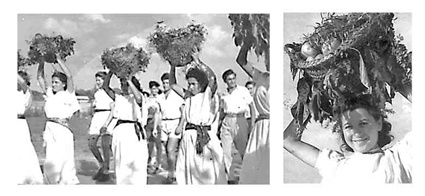
in a kibbutz high school - after school

Next time – Book II – Sydney Australia.

Renate

Artist, poet & the author of

"From the Promised Land to the Lucky Country"


Bicurim feast in the kibbutz highschool
Hi Walter and Annette, Thanks for the feedback. Pleased you enjoyed reading it. What happened to the boat, comes in a period after the book ends and maybe a part of the next book...