Even though I never stay on one subject twice in a row, the importance and relevance of comment below prompted me to reply in a form of a post; and I’ll start with the comment itself,
Hi Renate,
That is such a clear and easily understood explanation... I love it.
What a pity so many people don't recognise their own decision making decides the path of their future -
"...that by making their own decision they have taken their own future into their own hands. And, by making their own decisions, they have also taken responsibility over their actions, individually. The onus has now shifted to each of them according to their individual deeds..."
- and then they run to their lawyers to sue whomever, whenever a disastrous outcome has been the result of their silly, stupid thoughtless decisions actions in the first place!
Signed by Silkhobby.
I think that Abraham by embracing the whole of the universe in his monotheistic understanding gave us not only the understanding that the universe as a whole is inter-depended, but also the understanding that every action taken individually or as a group; has ramification that effect the whole of creation. Hence, our responsibility as an individual, and as a group or society, is of prime important.
We only need to look into what is happening today. We can see so vividly the outcome of human action taken during the last say, 50 years.
For example,
The pollution we have created through the use of fossil fuel, The mono-agriculture of annuals that brought about deserts and dust bowls, as well as salinity in the land, and much more.The list is endless.
And here comes the responsibility of the researcher in any other field of endeavour, as well as that of the various industries and commerce to look outside the small sphere of his/hers/their area of interest and see the broader and more embracing, long term results or influence of their action.
And here also comes the responsibility of society as a whole: It needs to become more responsible and responsive towards the world and the environment that give us life by sustaining it.
And here Abraham greatness lies. He understood this already 4000 years ago, and it guided us through the ages.
However now in the last hundred years or so, we have decided to forget it, for we think we know better, AND we, the society at large, are already ripping some of the unpleasant consequences of our actions.
Renate
http://www.promisedland-renate.com
Showing posts with label In Antiquity. Show all posts
Showing posts with label In Antiquity. Show all posts
30.1.08


24.1.08
Abraham
Having read several books where Abraham is mentioned, featured or talked about set me thinking: How come that Abraham, after 4000 years, is still here with us when all others ended in obscurity? He was never a deity or a person one prays to or for, nor is he religiously revered, and there is very little about him in the Bible itself. So what is it that has kept him alive? What type of a man was he that warrants this very unusual honour? I tried to build a picture of him, to understand his accomplishments, to figure out what did he give to the world, which made him unforgettable. There is a lovely legend about Abraham, from the days when he was still called Avram (Abram), Avram’s father, Terach, made and sold clay gods. One day he asked his son to look after the shop while he was gone. On his return, he got the shock of his life, Avram, he shouted, Why are all those idols broken? They had a fight and the big one won, replied Avram. Don’t be stupid. They are just clay figurines, said Terach And Avram replied, Yes. They are; so how come they are gods? And so, monotheism was born. I know that, I said to myself, Abraham was the father of monotheism. But what does it mean? It means that by him leaving the world he lived in, he created a one all embracing entity for his family to follow exclusively. It means that from then on his descendents no longer touch clay figurines and call them gods. They no longer allocate different powers to different things. Instead, they pray to that single entity they call God. A God that makes contracts and rules to be obeyed by both sides, under which he has the right to give when obeyed, and to deny when breached. A God no one can see, neither touch - a philosophical understanding that embraces the whole of Creation – A God that is abstract. This is all good and fine, but again, I asked myself, What does it really mean? It means that from that day on his decedents, and all others who cared to follow, realized that they are no longer a part of a world in which their future, deeds, or path in life are predetermined. They understood that they are able to think and act for themselves, because they made a contract, an agreement; a personal commitment they need to abide by. They learned to think ‘outside the then existing box’ so to speak. But what change did it bring to people’s daily lives? What did it entail? What it changed was, that by making their own decision they have taken their own future into their own hands. And, by making their own decisions, they have also taken responsibility over their actions, individually. The onus has now shifted to each of them according to their individual deeds – From that minute on they have become accountable for every move they took, under a contract to that unseen all-embracing God. With the birth of his son, Yitzchak (Isaac), Abraham takes a step foreword. He now looks into the health of his people by combating, to a large extend, the rampant venereal diseases of his time through compulsory circumcision. Having done that, he directs his attention to end the very prevalent practice of human sacrifice. It is with the dramatic story of ‘the sacrifice of Isaac’ that he changes religious offering from humans to animal, and human offerings are no longer acceptable. We in the western world take all these things for granted.But the foundation of the world we live in come from Abraham, that had the courage to follow his own believes and understanding; and as Paul Johnson in his best seller book ‘A history of the Jews’ asks, ‘what would have happened to the human race if Abraham had not been a man of great sagacity, or if he had stayed in Ur and kept his higher notion to himself…’
Renate
http://www.promisedland-renate.com
12.1.08
A tree from biblical times
Gerry said, ‘Come. I must show you something.’ ‘Show me what?’ ‘You’ll see’ He took me by the hand and led me behind the new art centre to the old part of Natanya, and I was surprised. What is there to see at this end of town? We got to a small park, and he stopped. ‘Look at this tree’ he said pointing to a very large sycamore, ‘It stands here from the days of old Israel.It is over two thousand years old!’ And what a tree: A trunk five meters wide at its widest angle; with a huge canopy, full of fruit and leaves and very much alive. Looking at it I wondered at the travellers it met, the wars he lived through and the lovers under its shade. From long into antiquity the Land of Israel was a transit land between three continents: between Europe, Africa and Asia.It had two main routes passing through it: one along the Mediterranean shore and the other over the mountain ridge; and it may very well be that this tree stood beside the main route along the sea. Egypt in the south, and the Hittites, Assyrian and Macedonians to the north, to name only a few, used these highways for commerce and their none-ending wars; in their quest for the then world domination.The ‘King’s Way’ was the one along the seashore, in Hebrew - Derech Hamelech, and the other -Derech HaHar – meaning - The ‘Mountain Route’. Standing there the uniqueness of the place overtook me. I looked, wondered and wished I could communicate with it. We returned, several times, to this small park that is not even a street away from the hustle and bustle of Natanya’s main street. We shot day, twilight and night photos, when the tree is floodlit, and included some here for your enjoyment.

 At this angle, the trunk is 5m wide
 A part of very old branch
 The fruit on its branches
 The tree at twilight
 A night shot
 A branch at night
Renate
http://www.promisedland-renate.com
A branch at night
Renate
http://www.promisedland-renate.com
A day shot
 Floor painting done by a traveler in 1873
Floor painting done by a traveler in 1873
At this angle, the trunk is 5m wide
A part of very old branch
The fruit on its branches
The tree at twilight
A night shot
A branch at night24.12.07
Chanukah - the festival of light
In this festive season Christians celebrate Christmas and Jews have already celebrated Chanukah. But what is Chanukah all about, this ‘Festival of Light’? What does it celebrates? Where does it take its name? From how far in history does it echo? And what is its message?
Chanukah celebrates a miracle that happened about two thousand one hundred and fifty years ago.
After the death of Alexander the great in 323BC when its empire was divided between his generals, the Seleucid dynasty came into being. The Seleucid, who ruled the area of Israel and Judea, continued Alexander’s policy of Hellenizing their territories.
Around the year 200B.C the Seleucid Antiochus IV came to power. Frustrated with his inability to Hellenize the Jews he eventually converted The Second Temple in Jerusalem to a house of pagan idol worship.

map of Jerusalem in antiquity.

The Second Temple is considered to be one of the seven wonders old world
In 167BC after three years of guerrilla warfare, against a numerically superior army, man named Yehuda haMaccabi(judas Maccabeus), son of Matityahu (Mattathias), recaptured Jerusalem and the Temple Mount, cleansing it from all idols.
After the Temple was cleansed, Yehuda and his men wanted to rekindle the temple’s eternal flame. They hunted high and low to find some blessed oil needed to light the flame on its seven-branched golden Menorah (candlestick), but all they could find was a tiny clay pot, which had enough oil for just one day.
On the 25th day of the Jewish month of Kislev, which corresponds to sometimes in the month of December, a miracle occurred and the Menorah lit for eight days, giving enough time for fresh oil to be brought up to Jerusalem.

The entrance to the Temple area
Chanukah lasts for 8 days, signifying this event. Every evening during these days the chanukiyah (the special candlestick used only in Chanukah) is ceremoniously lit with an additional candle for each night. On the last night all eight candles are alight, as well as the service candle used to light the others.
However, Chag (feast) HaChanuka celebrates not only the recapturing of the Temple, when Judaism was the only monotheistic religion in a sea of paganism, but also the survival of the Jewish spirit and culture. At the same time it raises awareness to the right of freedom over oppression.
Chanukah is a happy celebration, where people sing songs, play games and eat sweet and oily foods to denote the miracle.
We have come to evict the darkness,
In our hands a fire so bright,
Each of us is a small candle
Together we are eternal light.
Disperse, oh black darkness,
Disperse! Here comes the light!
Renate
http://www.promisedland-renate.com/
21.10.07
Masada – ‘Metzada’ in Hebrew – freedom or death
We are driving along the only road that leads through the Judean Desert south towards Masada. All is bare but for a patch of green here, and another one there, denoting a kibbutz; where a lot of effort is put in to make this desert bloom; a vast rocky emptiness that is hard to comprehend.
How can I make you feel this vastness? This emptiness? Its deadness if I can call it that way, even though there is life everywhere.I thought of showing you all that we have filmed, but then it will go forever, and still, it will not be it, will it?The Hebrew calls it‘
It is hard to comprehend that people in biblical times lived in this environment by choice, in small settlement like in Qumran, or in caves one can see along the way, till you realize that living here was better than living under the noses of the so cruel Romans.
 <
<The Judean wilderness, a kibbutz in the distance
Deep in the Judean desert, 450 meter above and overlooking the now receding Dead Sea, stands the mighty fortress rock of Masada. Majestic in its beauty, and fascinating in its history, it is a place of pilgrimage to all Israelis and many others around the world.

the rock of Masada

Arial map in blue
Here, after 3 years of siege, about 960 people chose death in freedom over life in slavery – Roman slavery, and I quote out of Josephus:
“Since we long ago resolved never to be servants to the Romans, nor to any other than to God Himself, Who alone is the true and just Lord of mankind, the time is now come that obliges us to make that resolution true in practice... Let our wives die before they have been abused, and our children before they have tasted slavery, and after we have slain them, let us bestow that glorious benefit upon one another mutually, and preserve ourselves in freedom.We were the very first that revolted, and we are the last to fight against them; and I cannot but esteem it as a favour that God has granted us, that it is still in our power to die bravely, and in a state of freedom.”
From Elazar benYair final speech (the Zealots Commander)
At the end of the 3-year siege, when at long last the fortress walls were breached, the Roman got the surprise of their lives - they were greeted with silence.
There was nothing for the ‘Triumph Parade’.No slaves for sale.
Apart of two women and five children that hid themselves, there were only dead bodies…
With the fall of Masada, the last resistance to Roman rule came to an end. Jerusalem was in ruin already and the temple no longer stood. After one more revolt in 132-135, Rome had enough. To ensure the Jews will no longer rise against her, the population was dispersed throughout the Roman world and Judea’s name was change to ‘Palestina’ – a name they coined from the name of the Philistines – the Anatolian ‘sea people’ who lived along the southern Mediterranean shore of the country and were long gone by that time.
Nowadays, Israeli soldiers take here the oath: "Masada shall not fall again."
Masada was first fortified was by ‘Jonathan the High Priest’ who lived in103-76 BCE.
Between the years 37 and 31 BCE ‘Herod the Great’, the crazy king, who killed anyone at a whim including his wife and children, and one of the world’s greatest architect, built into this rock his fortified 3 level summer palace, overlooking the Dead Sea. A palace in the best of Roman style; fit not only for a king but for an emperor as well. Here as in any other place he built, Herod spared nothing: Palaces and villas, throne room and synagogue; water cisterns, bathes, frescoes and storerooms and more.

Harod’s palace overlooking the Dead Sea
After the fall of Jerusalem and the destruction of the magnificent Temple, crazy Herod built; a group of zealots took Masada over.
Around 73 CE, Rome collected her best legions from all over its empire, and from as far as Britain, to lay the 3-year siege of Masada. They brought with them thousands of Jewish prisoners-of-war slave labour, to build rampart of thousands of tons of stones and beaten earth against the western approaches of the fortress; and battering rams to breached its walls.

Part of the way up the rock of Masada

View from above onto the Roman camp area
As you stand at the top of Masada looking down, you can still see the Roman army’s camp area and that of the slave’s as well.

The Roman rampant
There is so much about Masada to study and so many lessons to learn.Books were written and still are, and theories developed. Archaeologist have turned over and looked into every nock and cranny of this place, and Josephus, the Jewish General who fought the Romans in the Galilee and later Romanised to become the emperor’s friend and historian, left in his book ‘The wars of the Jews’ the only account we have today from that time in the history of the holy land.
Renate
http://www.promisedland-renate.com
If you want to know more go to
Masada photos
http://fourquestions.us/albums/Israel2006/Masada/photos/photo2.html
Masada history
http://www.jewishvirtuallibrary.org/jsource/Archaeology/Masada1.html
Subscribe to:
Posts (Atom)
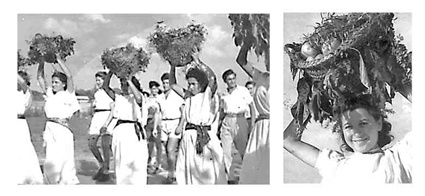
Bicurim feast in the kibbutz highschool


 promised land - renate

